“(T)he decline of a language must ultimately have political and economic causes …”
“Politics and the English Language”
George Orwell

In “HOMЯ”, the 257th episode of The Simpson’s, Homer discovers he has a crayon lodged up his nose. In a flashback it is revealed that when he was still a child he shoved sixteen of them up there. Although he was able to sneeze them out, one became lodged and caused an obstruction that resulted in a drastic reduction in his cognitive ability. In fact, later in the episode, when Homer’s doctors remove the crayon, his IQ miraculously jumps from 55 to 105.
Of course, this new found intelligence leads to profound changes in his life. On the positive side, he finally connects with his daughter Lisa. Over the course of the episode their relationship grows in a way that has eluded them in the past. But at work things prove more challenging. He is appalled by the conditions at the nuclear plant and writes a report that outlines all of the safety violations. This results in a shut down that leads to massive layoffs as the plant’s owner goes through the costly process of bringing it up to code. Of course this leads to even more conflict. Homer discovers that his longest and closest friends no longer wish to associate with him. In fact, towards the end of the episode, upon arriving at Moe’s Tavern, he discovers he is about to be burned in effigy.
——————————————————————————————————————————–
“I’m detecting a distinct strain of anti-intellectualism in this tavern.”
Homer Simpson
———————————————————————————————————————————
In the introduction to Stephen Brookfield’s book, The Power of Critical Theory: Liberating Adult Learning and Teaching, he relates an unsettling experience he had while teaching. In his own words: “As students were leaving the last class of the semester, I overheard one say to another: ‘I still don’t see why we had to read all this critical theory. What’s Gramsci got to do with adult education?’” Brookfield was taken aback by the comment. In many ways one gets the sense that Brookfield is attempting to address a wrong. He is not just speaking to the student who made the comment; he is speaking to everyone who has ever walked out of a class thinking the same thing. It is as if he has tapped us on the shoulder and, pulling us back in from the hallway, says: “Sorry about that. Could you give me just one more crack at this?”
Now, let’s be clear: you are never going to find The Power of Critical Theory propped up near the front entrance to Chapters with a gold label on it designating it as one of “Heather’s Picks”. In fact, a colleague who saw it sitting on the corner of my desk at work quipped, “This person is trying to be ironic, right?” And, no, for the record, Stephen Brookfield is not trying to be ironic. Critical theory is as difficult to get ones head around as it is misunderstood. Most people just turn away from it. But make no mistake, it is powerful. Critical theory is all about power. It is about getting it. Hording it. Keeping it. But most important of all critical theory is about understanding power. In fact, if you decide to pick up this book, you just might find yourself wondering if maybe it should be sitting near the front entrance to Chapters.
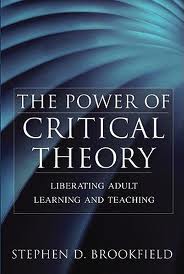
Stephen Brookfield — The Power of Critical Theory
Why?
Because Brookfield does something that most academics simply refuse to do. Instead of preaching to the narrow group of converts who have heard of critical theory, he reaches out to the ones who haven’t. And the finer point to be made here is that he attempts to engage these people through crisp, clear language that is accessible.
So who exactly is it that is walking out the door?
Well, during the attempt to rationalize the Metro Halifax universities in the 1990s, the Metro Presidents’ Council hired a pollster to do a survey of business leaders, bureaucrats and politicians in downtown Halifax. The reason they did this was to get a better sense of the tone in the community with which they were about to negotiate funding. The results left them aghast. Not only did these leaders think that academics were overpaid, they saw no contributory value to their work whatsoever. Simply put, they had no idea what they did or why they were being subsidized so heavily from the public purse to do it.
Anyone who thinks the results of this poll are insignificant is sadly mistaken. Shortly afterwards the provincial government began to engage more directly with the Nova Scotia Community College (NSCC). Whereas universities have watched the provincial portion of their funding whittled away, the College has not seen a drop in its government contribution since the late 1990s. And the reason for this is simple. The NSCC, which is by no means a perfect organization, has done two things better than anybody else. It has succeeded in rebranding the need for skills training. And, secondly, it has established a mandate for itself that has caused everyone in that downtown core to sit up and take notice. Its goal is to “improve Nova Scotia’s economy and quality of life through education and innovation.”
So does this mean that universities don’t contribute to Nova Scotia’s economy or quality of life? Of course not. One can point at pretty much anything from iPads to agriculture and play ‘two’ degrees of Kevin Bacon. University education has been one of the biggest game changers of the 20th century. If it wasn’t, China wouldn’t be building them at a rate of one every three months. The better question to ask is if people think universities contribute to our economy and quality of life. And the answer to that question is a simple and unequivocal, no. At least not anymore they do.
During the first half of the 20th century Canada’s universities did an astounding job of engaging not just their potential stakeholders, but society as a whole. Anyone who doubts this should consider reading Gwendoline Pilkington’s book, Speaking with One Voice: Universities in Dialogue with Government. But, once the funding taps were turned on in the late 1950s, universities more or less turned away from the table and got on with the work at hand. The result is the silofication of conversations that could and should be directed towards a wider audience. In other words, very few people are doing what Stephen Brookfield attempts to do in his book, namely transform important and difficult ideas into a message that is accessible.
Imagine for a moment what would happen if the faculty at just one of the Halifax universities decided to take upon itself to invest a small portion of their time attempting to engage more directly with society? I think three things would happen. The first is that they would encounter a shocking resistance to most of the things they have to say. Universities are, after all, the home of difficult truths. Homer Simpson learned this the hard way during his first brush with entrenched interests. The second thing this newly engaged group of faculty would learn is that communicating to a wider audience is a lot harder than it appears. Concise clarity is a muscle that most people choose not to exercise. And the third thing that would happen – and take note for this is important – is that this little band of scholars would come face to face with the cold reality that there is an awful lot going on in this tiny little city of ours that many people would prefer to go unnoticed.
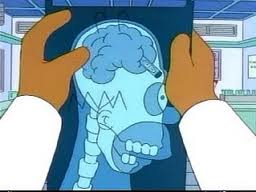 So what happened to Homer Simpson? Well, towards the end of the episode, he realizes that intelligence has reduced him to being a ‘Spalding Gray in a Rick Dees world.” He begs the scientists who inflicted him with this intelligence to take it back by shoving the crayon up his nose again. He just doesn’t have the courage to be smart and chooses instead to return to being the “blissful boob” he once was.
There are a lot of people out there who would prefer if our city’s scholars would just go away and shove a crayon up their nose. But, if that option is not up for grabs … well, then, I am sure that, for the time being at least, they are willing to accept a group of people who are content to chat amongst themselves.

