The Law of Comparative Advantage is one of the only insights to come out of the social sciences that is both true and non-trivial.
Paul Samuelson, economist and Nobel laureate
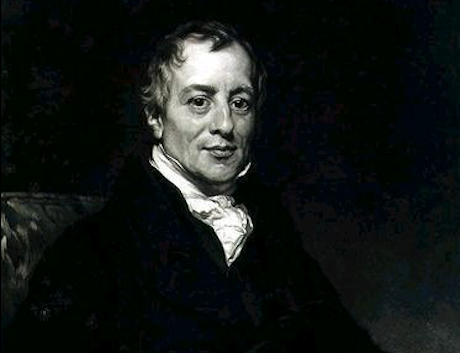
David Ricardo, British Political Economist, 1772-1823
When I was a student at Dalhousie University pursuing my undergraduate degree I would often head to the Dalplax between classes to squeeze in a swim. For anyone who was there during the early 1990s, you may remember that the Alumni Office was lodged in a small brown house nestled next to a path that curled down a hill towards the facility. The two buildings even shared a sign. The top half of it was brown and had the word ‘Alumni’ marked in bold black letters. The bottom half had the Dalplex insignia in blue and white.
I don’t know why, but for some reason I made the mental leap that Alumni was Latin for pool. Now, in my defence it wasn’t the first strange word I encountered during my undergraduate degree. During my first year words like Baccalaureate and Faculty were being tossed around all over the place. Indeed, I distinctly remember a friend who cornered me in the Quad one afternoon to tell me I needed to go to the Registrar’s Office to pick up a calendar. When I got there I had trouble concealing my surprise when the woman behind the desk handed me a book instead of something I had planned to pin on my bedroom wall.
Now, I faked my way past most of these strange words. You just nod and look non-pulsed while secretly hoping no one asks you a question. Eventually the meaning of these words begins to emerge and you arrive at this point where you forget that there was ever a time when you didn’t know what they meant. In fact, you start tossing them around expecting everyone else to know what they mean.
I think I could have easily gone on to become an academic snot – you know, that guy in the corner of the King’s Wardroom with the fake British accent, smoking cigarettes, pretending to be much smarter than he actually is. Well, unfortunately for me, the Dalhousie Alumni Office proved to be my downfall. While at a party at a friend’s house on a cold winter’s night in February someone asked me what I did that day.
“Oh, I went for a swim in the Alumni.”
Up to that point I had tossed the word around all over the place. I thought I was impressing people with my vocabulary. (And, oh, the looks I got when I did!) The worst part is that this went uncorrected for much longer than I care to admit … let’s just say it may have lasted a tad bit longer than an academic term. But when I used it that night at my friend’s place the room went silent. There was just the beating of the music with everyone staring at me. My friend Brad shook his head and said, “You know you are an idiot, right? Cause only an idiot would think he could swim in an Alumni.”
I share this with you because this rather painful memory jumped to mind when I was about halfway through Michael Tomasello’s book, The Origins of Human Communication. It was around that halfway point that he began to argue that language needs an entry point. In other words, if people did not possess innate commonalities, then children would never be able to break into language. They would do exactly what I did upon seeing that sign marked Alumni: they would make the wrong mental leaps and would, in turn, fail to gain the traction needed for language to take hold within us. For me this makes perfect sense. (One might even say it makes painful sense.) In fact, I can honestly say there was very little in this book that I wanted to dispute. What I did end up doing, though, was find myself making connections to some other stuff I had read.
In Harnessed: How Language and Music Mimicked Nature and Transformed Ape to Man Mark Changizi, an evolutionary neurobiologist, takes a similar, yet slightly different bent on Tomasello’s argument. In Changizi’s book he argues that nature tricked us into developing language. As a species we are hardwired to hear much better than we see. It is a survival mechanism. In fact we are so good at hearing that it is almost impossible to sneak up on a person.
Interestingly enough, what we are not so good at is seeing. For example, children learn quite early that it is far easier to surprise someone by concealing themselves behind a tree or a bush and then wait for someone to walk into their space than it is to actually sneak up on someone. Why? Because we will hear them long before we see them. And it is for this reason, he argues, why language and music developed long before the written word. Language shaped itself over time to resemble what our auditory system is good at processing whereas the written word molded itself around what the visual system is good at seeing. The problem is that one system is better than the other.
Changizi puts forward an interesting argument to support this. If we go back just two generations very few people in society could read and write. In fact writing only goes back about 6000 years. According to him this is just too short a period of time for us to make the argument that we have evolved into being able to read. Instead, what he argues is that the written word has done the exact same thing that happened with the spoken word. We read as if we have a reading instinct, but what is actually happening is that the written word has harnessed upon a part of our visual processing system designed for something completely different. In essence Changizi argues that reading, writing and music are emergent behaviors.
So, with all of this in mind, I found myself wondering why this just happened to us. Surely these instincts are shared by other mammals. Why didn’t monkeys allow themselves to be harnessed?
Well, the answer may surprise you.
The Mathematician Stanislaw Ulam once challenged the economist Paul Samuelson to name one theory to come from the social sciences that was both true and nontrivial. It took Samuelson several years, but he eventually came back with the Law of Comparative Advantage. The idea, which was first captured by the British political economist David Ricardo, basically boils down to the fact that when people exchange they almost always end up with more than they bargained for. It is counter-intuitive. In other words we are almost always better for having exchanged. In fact, our ability to exchange is cited in a growing amount of research as one of the primary traits that differentiated us from one of our closest ancestors, the Neanderthals.
As Tomasello points out time and again throughout his book, sharing is something that humans do that apes and other mammals don’t. In fact, I would argue that humans have a complicated relationship with sharing. We have an instinct to compete that runs deep and can be traced right back to our closest mammalian relations. But we also have an incredibly strong desire to share that most of the time overrides our competitive instincts. It is something we nurture in our children, and I would argue that it is a behavior we stumbled upon at some point in our development.
In a way that was about the only thing I found disappointing about Tomasello’s book. Never at any point did he mention or even cite Ricardo’s Law of Comparative Advantage. This law has been around for a long time and it goes a long way in explaining why we as a species have been so successful.
But I could be wrong … God knows I have been wrong in the past.
READ: Harnessed: How Language and Music Mimicked Nature and Transformed Ape to Man
READ: David Ricardo: On the Principles of Political Economy and Taxation


Karl
Very perceptive, interestingly written and persuasive. I really like the way you development and support your thesis, especially outside readings. You raise an interesting point that Tomasello did not raise Ricardo’s Law of Comparative Advantage and it would appear to support the concepts of Tomasello. Your blog also has a really professional appearance … Well Done! You are setting the bar!
Thanks
Kevin