Life is political, not because the world cares how we feel, but because the world reacts to what we do.
Timothy Snyder
Big things come in small packages.
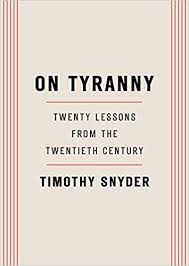
That is what I thought when I noticed On Tyranny sitting on the shelf at my local bookstore. One could easily be forgiven for missing it. At six inches tall and four inches wide, it is a tiny sliver of a book. But in one hundred and twenty-five pages its author, Timothy Snyder, conveys an important message. Snyder is an American academic who specializes in Central and European history. He is also a member of the Committee on Conscience at the United States Holocaust Memorial Museum. Indeed, most of the lessons in this book draw upon European atrocities.
I must admit when I picked it up I struggled with whether or not to buy it. It was Christmastime and I really should be getting presents for other people. But its simplicity caught my eye and in the end I succumbed to the worst sin a reader can commit: I judged this book by its cover and bought it.
Over the Holidays I kept it on the nightstand next to my bed. Each evening, after climbing under the covers, I would read a chapter. Most are only four or five pages and can be covered in less than five minutes. To my surprise, the words I used to help lull myself to sleep each night came to haunt my waking hours.
This book delivers on its promise in that each of its twenty chapters is a lesson drawn from the previous century on the nature of tyranny. Now, I expected these ‘lessons’ to be historically remote if you know what I mean. Because they are drawn from twentieth century history I expected them to be far away from me, but interesting in an observational way. To my surprise, though, each one landed unsettlingly close to home.
Tyranny, Snyder argues, is neither far away nor defeated. It is not an historical concept that died with the Nazis. Nor was it abandoned on the steps of the Lincoln Memorial after Martin Luther King shared his dream with us. To the contrary, tyranny lurks in the dark corners of our daily interactions with the world.
What you learn from this book is that Jian Ghomeshi’s behavior while at the CBC is a form of tyranny. The same is true for Kevin Spacey and the long list of other celebrities who have fallen in the past few months. Broadly speaking, anyone who tries to couch, conceal or conspire to silence a dissenting position is guilty of tyranny. The scope for bad behavior is no longer as wide as it was in the twentieth century. In other words it is now really hard to be a Hitler. But in a democratic society dominated by a network of corporate hierarchies it is all too easy to be a Weinstein.
When I was doing up my list of New Year’s resolutions I decided to include a lesson drawn from this book: Stand Out. And why not? Snyder argues it is important in a well-functioning democracy. “Someone has to. It can feel strange to do or say something different. But without that unease, there is no freedom. Remember Rosa Parks. The moment you set an example the spell of the status quo is broken, and others will follow.”
If you are drawing up your own list of resolutions, you might want to include reading this book. Democracy and freedom will thank you.
- READ: Timothy Snyder on Real Time with Bill Mahar (HBO)

